
52 questions for 2026
Each inspired by a glimpse of the future normal from the last 12 months.

2025 was strange. Your non-technical colleague excitedly showed you their new vibe-coded app. You used live translation to talk with someone, even when you were both speaking different languages. Friends shared videos of their first driverless car experience. You started speaking to your phone – not on calls, but to apps.
Yet once you experience these sci-fi staples, they quickly move from mind-blowing to mundane. This paradox – exponential technological change folding seamlessly into a remarkably stable daily life – is the future normal.
The best leaders and innovators build bridges between these two worlds; making the revolutionary feel unremarkable.
This list will help you do just that. Its 52 questions – each inspired by a new product, experience or startup story from the past year – will provoke you to think about the opportunities that will open up in 2026.1
Yes, there are lots of AI-related stories. But each one is anchored in something deeply human: trust, identity, meaning. And alongside AI, you’ll also find mind-altering shoes, sweet proteins, and a basketball court that doubles as a storm drain.
I’ve kept it deliberately eclectic. These aren’t the ‘biggest’ trends for 2026. And they’re not split out by category. Cross-pollination beats specialisation; your edge will come from a seemingly-unrelated observation sparking a non-obvious insight.
Let’s go…
What if the most valuable future skill is describing problems, not solving them? Goldman Sachs is piloting Devin, an autonomous AI software engineer. Its CIO says its human engineers will need “the ability to describe problems coherently and turn them into prompts.” Schools today teach skills; AI will reward those who can articulate what needs doing.
What if AI could help your (human) employees collaborate? Even when AI does the work, people will still need to talk to people to coordinate. Microsoft People Skills uses AI to automatically infer employees’ skills from the work they perform in its product suite. I often refer to it as “Waze, but for people”.
What if everyone can become an expert-on-demand? IFixit’s FixBot helps people repair broken appliances and devices, drawing on the site’s detailed bank of validated content; Google’s Camera Coach helps people take better phone photos, with in-the-moment, relevant guidance based on what’s on your screen.
What if your work equipment trains your team? Amazon’s AR smart glasses are all about improving its drivers’ efficiency (of course they are ;) But the non-obvious insight is that skill development will come from just-in-time guidance, built into the work itself. This is what the future normal “centaur” workforce looks like.
What if AI handles admin, freeing artisans to focus on their craft? Arcade’s AI agent, “Maia”, enables customers to design custom jewelry or home decor via through conversation; items then get handmade by vetted artisans. Where and how could you leverage AI to help your humans do more of what they love?
How will we encourage people to work with AI, rather than feeling surveilled by it? Nairobi-based Penda Health’s AI Consult tool features ‘traffic light’ nudges which support doctors’ work, rather than replace it.
Where will you still hire humans? Both in terms of where in the org chart, but also where will they be located? Klarna backtracked from its bold AI customer service bet in 2024 and is re-hiring humans, but remotely. RTO, WFH, WFA… the conversation will continue in 2026 and beyond; one size won’t fit all.
What if we could test and learn in virtual worlds? Google DeepMind’s Genie 3 showed a future normal where we can create realistic interactive digital environments, and where failure is ‘free’.
How will we prove that we’re human, and secure people’s trust? Chinese smartphone brand Honor launched its native Deepfake Detection feature, with its devices showing a popup warning if it suspects a video caller to be a deepfake.
What if your audience becomes your creative department? Disney used to threaten to sue fans for IP infringement. Now it’s inviting fans to use OpenAI’s Sora video generation tool to create movie clips featuring 200 of its iconic characters, with the best being available on Disney+. Nothing should be sacred…
What if you could create a shared vision of your future at your next all-hands event? Self-promo alert ;) Regular readers will know all about VisuAIse Futures, my interactive keynote. But they won’t have seen this new video (below), which captures the experience. Read why this is transformational, not just for events, but for your organisation’s culture, too.
What if AI re-writes the “rules” of capitalist economies? Google DeepMind’s C2S-Scale 27B AI model discovered a new potential cancer therapy. But the most interesting wider implication was how it offered it to researchers for free (as it did with AlphaFold previously). What if giving away valuable IP becomes the future normal?
Where will friction signal value? Both Apple and Google now offer live speech-to-speech translation; yet the more efficiently a practical task becomes, being able to do it ‘unassisted’ will become ever more impressive – language learning is about to become a luxury good (and this counter-trend can be applied to half this list ;)
What if culture becomes both hyper-local and global? A related fascinating stat – the web is no longer majority-English language, but AI dubbing and translation means local and global content – and therefore culture! – will cross borders more easily than ever.
Which services will robo-retail make more accessible? Last year I highlighted robot massages and dental crown placements; this year has seen automated hairwashers come to Hong Kong and custom nail polish stations in Walmart. Expanding markets > replacing jobs.
What if supply chains become end-to-end autonomous? Hyundai’s 750-foot cargo ships will cross oceans without crews by 2027; Aurora’s trucks are navigating its Sun Belt freight corridor without drivers; the Pickle Robot Company’s loaders are moving pallets into warehouses without breaks or injuries.
What if traditional industries embraced and even collaborated with their own disruptors? The world’s first cultivated meat farm will open in the Netherlands in 2026. Most interestingly, it’s located on Corné van Leeuwen’s existing dairy farm – tapping into the farmer’s industry experience and knowledge.
What happens when we reach the autonomous vehicle tipping point? I took my first Waymo this year. I wasn’t alone – passenger miles in California’s driverless taxis were up 8x in a year. As always, this will have fascinating ripple effects far beyond the auto industry…
What if accessible infrastructure is more important than technology? Berlin, Amsterdam and Dubai now offer battery-swapping services, making it more convenient than ever before to switch to e-bikes, by reducing battery anxiety.
What don’t we notice that future generations will consider deeply weird? One of my favorite AI use cases is making videos of future influencers, looking back in horror at things we do today without thinking – like wrapping food in plastic.
What if your children didn’t have to choose between a smartphone and safety? A clever twist on the smartphone-free childhood is the Other Phone, a collaboration between Nothing, SafetyMode and Mumsnet, which offers a safe smartphone experience that evolves as a child grows up.
What if we don’t need to constantly pull out our smartphones any more? Meta’s Neural Band gesture-based wearable and its Meta Ray-Ban smart glasses are an early signal that we’re inching into the post-smartphone era.
What if phones and gaming could bring people together, not keep them apart? StarStarter is a mobile game which researchers found reduces social anxiety.
What if AI could inspire people to re-engage with poetry? This year I’ve met two brilliant minds creating ‘tradition-with-a-twist’, AI-augmented experiences: Justus Bruns’ Poem Booth, and ‘poetechnologist’ Lauren Ducrey.
What if quantum solutions could run on existing infrastructure? It’s rare to read a quantum story that I actually understand. Well, here’s one – Toshiba’s researchers sent quantum-secured keys across Germany on existing commercial optical fiber. If this scales, we’d unlock quantum benefits (theoretically unbreakable security), without needing entirely new network infrastructure.
How will GLP-1s reshape the economy? Households on GLP-1s spend 6-8% less on groceries, but 4-5% more on clothing and, most interestingly, more on restaurants. Just as with the shift to autonomous vehicles, it’s the second-order implications that will be biggest.
What if buying new becomes a novelty, rather than the norm? 93% of Americans bought something secondhand in 2025, and more than half sold something.
What if loneliness became a global public health priority? June saw the WHO Commission on Social Connection launch its flagship report, outlining the scale of the problem and how we might address it.
What if we’ve passed peak social media? The FT reported data which appears to suggest this is the case. As AI slop and algorithmic “enshittification” degrades the ‘social’ media experience further, we can but hope…
What if healthcare becomes ‘invisible’, embedded in mainstream consumer devices? Apple’s AirPods Pro 3 act as a clinical-grade hearing aid, making it easier, cheaper and more accessible for millions with low-level hearing issues to hear better.
What if we could unlock better-than-human physical abilities? The fiendishly clever Provuu XR ski goggles enhance visibility in low light, helping keep skiers safe in poor conditions.
What if tripping became a status symbol? Could Bryan Johnson’s slightly bizarre 5-hour live stream of his magic mushroom experience help reduce stigma around “Psychedelic Wellness”, as we called it in The Future Normal. As the billionaire has said (about himself, I know ;) “Bryan Johnson in 2025 is a normal dude in 2030.”
Where will you sit on the AI-to-human content spectrum? Will you put out ever-crazier and dopamine-spiking fantastical AI-generated ‘impossible’ clips? Or will you lean into the authentically human, as Tod’s did with its “Artisanal Intelligence” campaign?
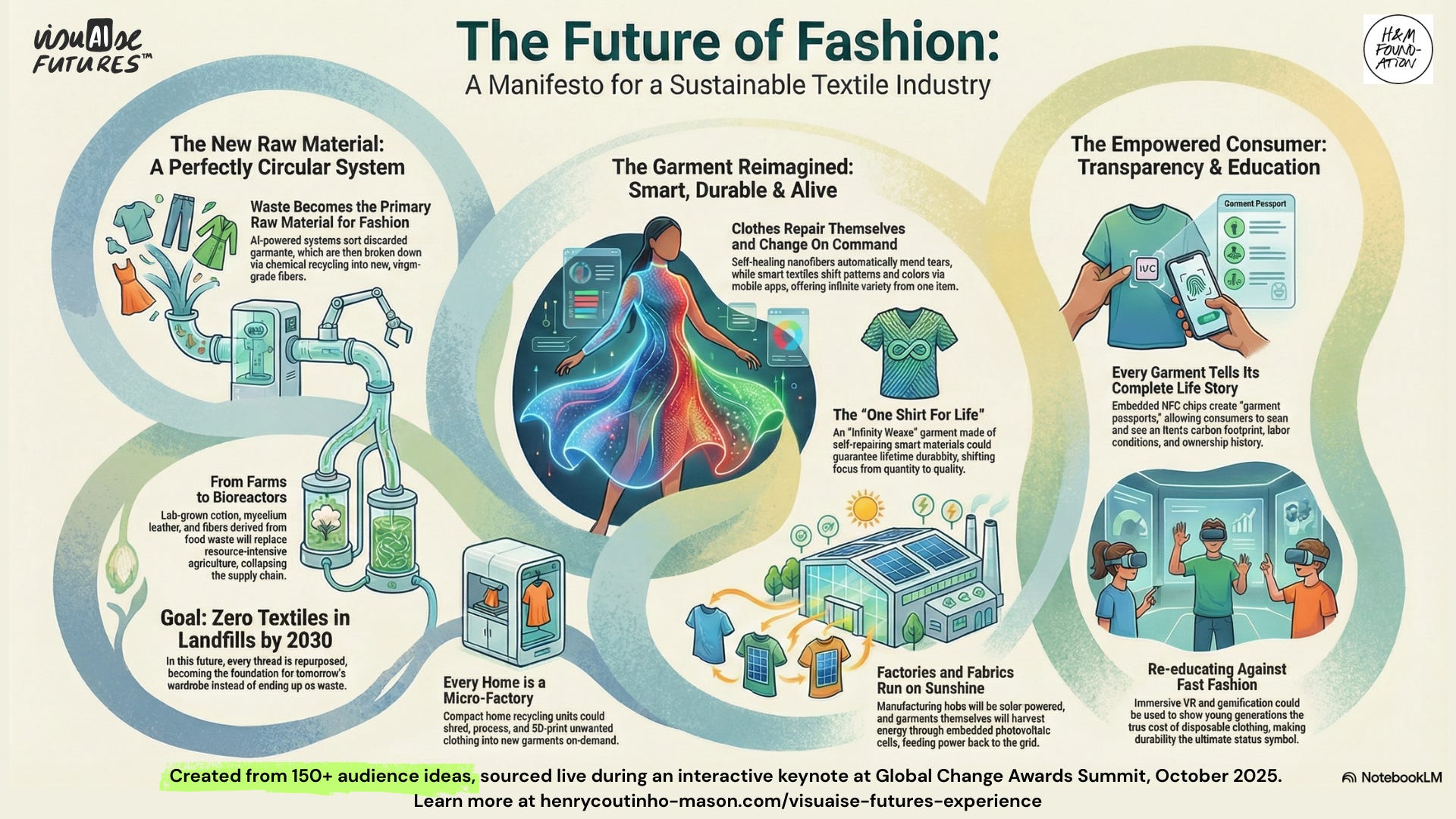
How will you avoid adding to the torrent of AI slop? Nano Banana Pro is astonishing. But so much AI-generated content is intrinsically hollow, because of the lack of effort it requires. One solution? Do something that wasn’t previously possible – and invite multiple people to co-create it, with AI. Here’s one that I (along with 150+ fashion innovators!) prepared earlier (and five more, co-created at other events):
What will be the unintended consequences of technology? Police received nearly 700 emergency calls from smartwatch-wearing rock fans ‘colliding’ in mosh pits at the Download music festival.
Will 2026 be the year of vibe-based products and services? 2025 saw an ‘emotional bookstore’ land in Naples, and an emotion-based cocktail bar in Tokyo. Emotions will feel like an antidote to data- and algorithmic-driven direction, giving people a sense of humanity and control.
What if AI could unlock “impossible” customer experiences? After Estée Lauder rolled out a chatbot with “a fluttery, poetic tone”, online shoppers who used the tool made Jo Malone fragrance purchases at almost double the rate of those who didn’t.
What if data centers contributed water to local communities? Data center resource use surged into public consciousness in 2025. ECL’s 3D-printed, modular, hydrogen-powered, zero-emission data centers flip this, sharing their cooling water by-product with communities.
What if we made climate solutions modular and affordable? Window-mounted heat pumps are cheaper, less invasive, and easier to install, even in apartment buildings.
What if community infrastructure was also climate infrastructure? This sunken NY public basketball court doubles as a storm drain. Recreation, meet resilience.
What if we could “upgrade” natural materials? The awesomely-named SuperWood is nano-engineered to be denser, stronger and more fire resistant, giving it up to 10x the strength-to-weight of steel.
What if we could take the e- out of e-waste? These fungi-based biobatteries are non-toxic and biodegradable, and could generate enough energy to power small sensors.
What if what you wear could affect your mental wellbeing? Nike’s first “mind-altering shoe” promises to activate sensory receptors in your feet, helping athletes focus better and recover faster. Wild.
What if your annual eye exam became your whole-body checkup? Mediwhale’s AI analyzes simple retinal images to detect heart, kidney, and metabolic diseases – replacing invasive blood tests and CT scans.
What if depression was as much a gut disease as a brain one? This fascinating study showed probiotic interventions having a positive impact on patients with depression.
What if you didn’t need glasses or surgery as you age? Older people naturally lose their near vision (hello reading glasses!). VIZZ eyedrops, which received FDA approval in July, restore patients’ near vision for up to 10 hours.
What if a once-a-year injection could cure HIV? Lenacapavir appears to protect people against HIV for a year, eliminating the need for hard-to-stick-to daily pill regimes.
What if we could watch over the whole world, continuously? Firesat aims to use its network of satellites to detect wildfires anywhere on earth, within 20 minutes of them starting.
What if the future looked exactly like the present? Jackery’s curved solar roof tiles look like standard terracotta roof tiles, meaning fewer planning objections.
What if “healthier” stops meaning “less delicious”? Oobli is a ‘sweet protein’ derived from the fruit of the West African katemfe plant. 1000x sweeter than sugar, but digested like protein, it means food can taste the same, without sugar’s negative health impacts.
What inadvertent learnings can you take into 2026? One personal accidental triumph was an early 5pm SXSW dinner. Sometimes logistical constraints end up showing you what people want far better than any grand plan.
How will you navigate through the ‘gentle singularity’? One of my favourite posts this year was this one from Sam Altman, which noted that despite all the huge advances in technology, for most of us, most of the time, life feels “much less weird than it seems like it should be”.
There’s a truth to this. Indeed, as I noted at the start of this piece, even if all of the innovations listed above became widespread or mainstream in 2026 I suspect life would still feel profoundly normal.
That might feel unambitious (certainly compared to the grand plans I hope you have in store for 2026 ;) It’s not at all. Indeed, it might be the most ambitious thing you can aim for – making the impossible feel inevitable.
Good luck!
Can I inspire your team to think differently in 2026?
Now for the call to action. In the last 12 months I’ve delivered 30+ sessions, both live and virtually – from Athens to Austin, Berlin to Baku, Chicago to Chelsea, and from Dublin to Dubai (okay, I’ll stop now ;)
If you’re lining up an event – from a company-wide strategy session or a customer conference – and want to move beyond “yet another AI keynote”, to an accessible, engaging, and genuinely useful creative experience with AI, then please do reach out to Renee Strom, or check out this YouTube playlist of some of my recent sessions.
Thanks for reading,
Henry
PS/ I’m also kicking off the year with a very special event London on 15 January, along with Joe Pine (to celebrate his new book, The Transformation Economy), and a host of other brilliant authors and thinkers.
It’ll be an intimate salon where the guest list is as exciting as the agenda – five international CEOs, a chief customer and a chief strategy officer; with sectors ranging from finance & investments, media & entertainment, to climate solutions.
We have a handful of seats remaining. To request an invite, head here »

Here’s a quick recap of the innovation-focused approach to trend spotting I laid out in Trend-Driven Innovation (which turned 10 this year!):
Forget trends. Look for opportunities.
Opportunities lie in the gaps between people’s emerging expectations and their current reality.
Expectations are created by people’s experiences, which can be direct or just indirectly being aware that something is now possible.
Look at innovations – i.e. new startups, products and services – as these shape people’s experiences.
Not all innovations are equally important (to you) – look for those that raise people’s expectations around a core, unchanging basic human need or want that you cater to.
They will lead you to identify meaningful expectation gaps. Ask ‘so what…?’ and ‘what if…?’, instead of stating ‘this will…’ Tell stories to inspire action rather than presenting data to convince.
Really thought provoking Henry - thank you. I liked this best, a subtle and interesting thought - "Where will friction signal value? Both Apple and Google now offer live speech-to-speech translation; yet the more efficiently a practical task becomes, being able to do it ‘unassisted’ will become ever more impressive – language learning is about to become a luxury good (and this counter-trend can be applied to half this list ;)"