
Raising the AI ambition level (at events, but also everywhere)
Field notes from doing things that weren't possible before.

It’s been so long since I sent a newsletter, that many of you will have forgotten what you signed up for. This year has taken me to a place that, to be honest, I never expected. But I want to share why I’ve been quiet (and why it matters to you), for three reasons:
First, the semi-selfish one. Over the last few months I’ve gone deeper than I would have imagined in building out an AI ‘product’ – my interactive keynote, VisuAIse Futures. It’s started to see real traction, and I’d love some of you to see it and think, “we could use this.”
Second, more importantly, the journey I’ve been on is one that many of you are also wrestling with – how will AI change my job, and how can I make sure I’m on the right side of this crashing wave? I hope my story can show you the art of the newly possible.
Third, I also want to share what I’ve built because it highlights another, often-overlooked, dimension in the AI conversation: that we need to be both far more mindful but also more ambitious when thinking about how we deploy this technology.
(Important note: I advocate for AI in many areas, but not when it comes to writing these updates. All the en dashes here were typed with my own human fingers ;)
Raising the AI ambition level: today
This year, I’ve sat through well over 100 presentations on AI. The dominant theme is efficiency: how much faster can you move with AI? How much of what we do today can we automate?
Yet there are two big problems with this focus on efficiency and speed.
First, it’s scary for most people. CEOs and CFOs get excited about automation, because they see cost savings. Employees see job losses. (And then the C-suite wonders why their organisations aren’t rushing to embrace AI…)
Second, more subtly, it ignores the nature of generative AI. Gen AI is unpredictable. As anyone who’s tried to apply it in contexts where details matter, you’ll know how hard to control its output. Now, it’s not surprising that we’re applying our our 50-year-old mental model of computers as reliable and precise efficiency machines. But it’s not helpful.
Generative AI is different; we should use it differently. I love Aaron Levie’s insight that “the biggest opportunities in AI will not be just doing what we already do at a lower cost, but instead solving problems that the customer previously didn’t solve because it was too expensive or inefficient to go after before.”
This quote for me gets right to the heart of how we should think about generative AI. Instead of asking, as most presenters and articles do, “which tasks can you use AI for?” the far better question is:
“What are you not doing today, which gen AI now enables you to do?”
In my context, as a keynote speaker, this means unlocking the ability to ask a room full of 100s if not 1,000s of people to share their ideas, while I’m live on stage.
It was previously impossible to ask this number of people for their input, beyond using tools like Slido or Mentimeter. But let’s be honest, has anyone ever been emotionally engaged by a live poll, or seeing a word cloud appear on the big screen? That’s only a semi-snarky criticism – there was simply no alternative to being horribly reductive when it came to live engagement.
Now, I ask everyone to sketch their idea (and thanks to gen AI’s interpretive powers, terrible drawings aren’t a barrier!). Then, in a few moments we can transform their quick, rough, analog inputs into a rich body of content that is exponentially both more accessible and more insightful than would ever be possible without AI.


The individual transformation is impressive: beautiful images, AI ‘roasts’, summarised idea cards, Deep Innovation reports assessing the idea’s potential feasibility and giving a draft launch plan…
…but it’s the collective live experience that’s far more interesting: we can show everyone’s ideas on the big screen, create a mind map of the key themes, and even a podcast discussing those themes (that you can interrupt and ask questions to!).
Then, within 45 minutes after coming off stage, I’ve created an online ideas portal and various strategic analyses for people to explore further.
Check out an example here, where we asked a room full of fashion innovators to “imagine an innovation that could decarbonise the textile industry”.
Pull this all together and it radically transforms the experience and value of an event by:
engaging audiences at scale, in a fun, creative way
capturing ideas, inclusively and democratically
unlocking proprietary data and aggregated insight
generating shareable visual artefacts
making all these accessible and actionable after the event ends
On top of all of this, you might have noticed when it comes to gen AI creations (much like baby, drinking, and drug stories) – your own feel exciting and magical…but other people’s? Mostly ‘meh’.
That’s why co-creation, or as I prefer to call it the ‘multiplayer experience’, is so important – it increases people’s desire to engage with the content, as they’ve had a hand in its creation (psychologists call this the IKEA effect).
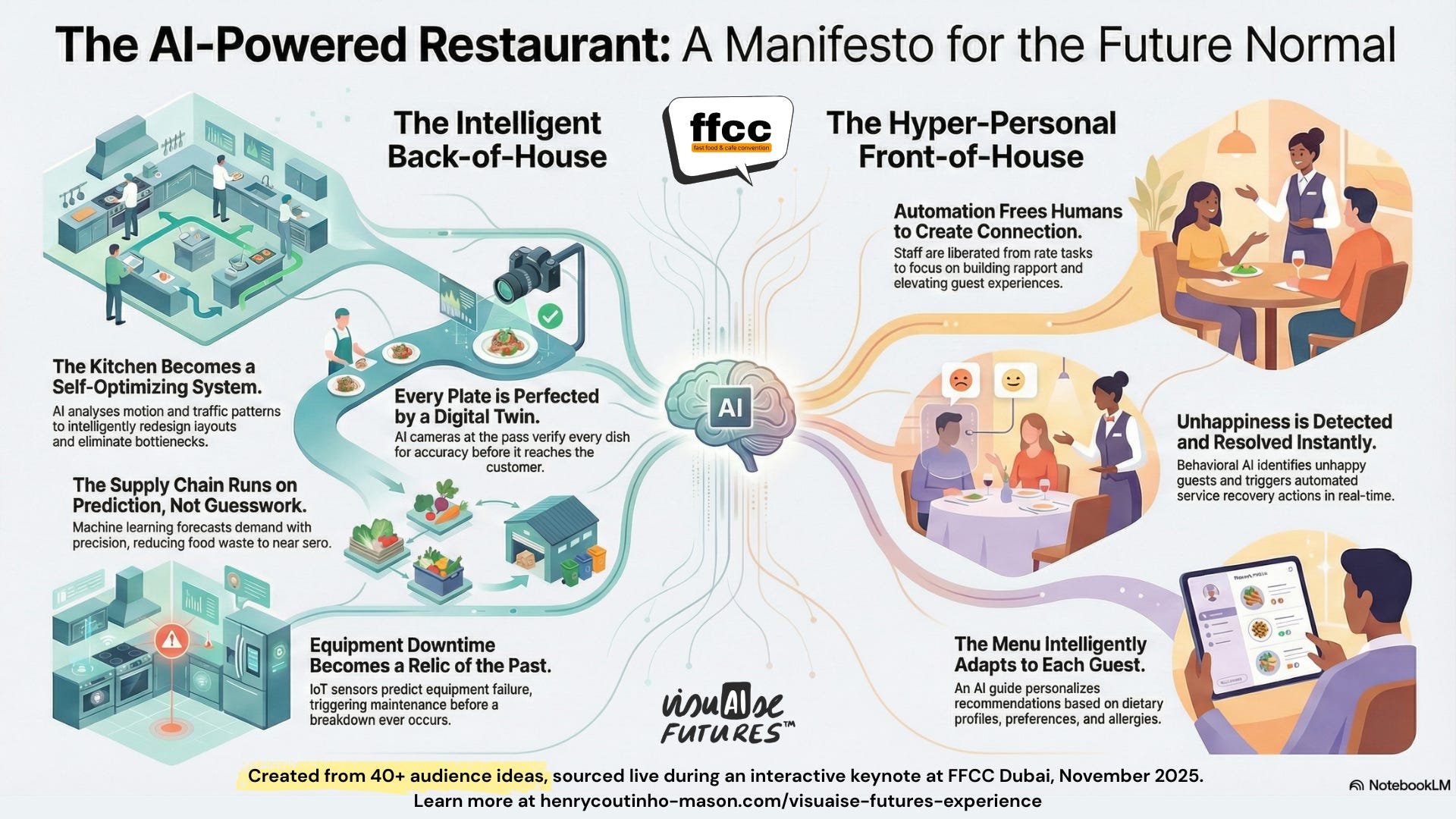
Check out 5 further crowd-powered infographics that I’ve created in the few weeks since Google’s Nano Banana Pro unlocked this new superpower… and crucially, some further thoughts on why these land differently to other AI-generated slop (hint: it’s the co-creation, stupid ;)
Raising the AI ambition level: tomorrow
True transformation isn’t about inputs and experiences, but of outcomes.
VisuAIse Futures isn’t just about the transformation of sketches into business plans & ideas portals. It’s a metaphor for how AI will expand people’s capacity & capability to get ideas good enough to share. And that won’t just mean more new ideas will be shared. But these new ideas will also come from new places and new people. What does it mean for organisations and communities when they can invite everyone to share their ideas?
Perhaps YouTube, Instagram and even Substack are parallels. We get a lot of cr*p, but there is also still a firehose of brilliance. More importantly, these platforms unlocked new economic models for culture and creativity – that were fundamentally different to what came before.
I’m painfully conscious that we’re still just scratching the surface of what’s possible. I urge event organisers to think far bigger than just using AI for the ‘obvious’ tasks – personalised agendas, session summaries, or half-baked attendee matching using out-of-date LinkedIn bios.
Instead, they should be fundamentally reimagining what an event can deliver – becoming generators of strategic insight, rather than just a moment to broadcast information (bluntly) and strengthen culture (patchily).
This isn’t just about events. Whether you work in customer service, marketing, sales, design, L&D or product – what are your word clouds, the not-really-good-enough-but-all-we-could-do-before “solutions”? Where were you settling, constrained by what was possible? And beyond faster or cheaper, what could better look like now?
Talking of transformation, I’m kicking off 2026 with an event that I’m truly excited about. I’m part of The Transformation Architects, Alain Thys’ collective of thinkers and doers.
When we learned that Joe Pine would be passing through London on 15 January for the launch of his new book The Transformation Economy, we wanted to host an intimate salon to explore this topic in a far more intimate, diverse and deeper way than your typical event.
With most of the seats gone, the guest list is shaping up to be as exciting as the agenda – 5 international CEOs, a chief customer and a chief strategy officer; with sectors ranging from finance & investments, media & entertainment, to climate solutions. It’s going to be a once-in-a-lifetime experience.
For more information and to request an invite, head here »

Raising YOUR AI ambition level: 2026 and beyond
At the top of this piece, I said that I hoped my story could also inspire some readers to dive into their own AI projects. Because despite now making most of my revenues from this AI product, I’m still certainly not an “AI guy”.
I haven’t vibe coded VisuAIse Futures (trust me, the last thing you want when standing in front of hundreds of demanding executives is for the tech to fail!). I’m also no blanket AI evangelist. I get hugely frustrated with all the LLMs I use on a daily basis.
But when you find the ‘right’ AI use case – i.e. one where you work with the technologies strengths and avoid its weaknesses – you can do more, with less than you’d imagine.
Most of what we do with people’s sketches today wasn’t possible six months ago. Indeed, it’s been nearly a year and a half since my initial “wouldn’t it be cool if…?” idea, but it’s really been the last six months or so, as the models have improved, that we’ve leaned into building and expanding our ambitions for this.
Be ambitious yourself. Think big. Don’t compromise. What you dream today will very likely be within reach tomorrow.
You still need a vision. You still need taste. You still need to be agile and adaptable. But if you’ve read this far, I’m going to humbly suggest that you score above average on those traits ;)
This is our time to imagine. This is your time to create.
Can I inspire your team to think differently about AI?
Now for the call to action. In the last 12 months I’ve delivered 30+ sessions, both live and virtually – from Athens to Austin, Berlin to Baku, Chicago to Chelsea, and from Dublin to Dubai (okay, I’ll stop now ;)
If you’re lining up an event – from a company-wide strategy session or a customer conference – and want to move beyond “yet another AI keynote”, to an accessible, engaging, and genuinely useful creative experience with AI, then please do reach out to Renee Strom or check out this YouTube playlist of some of my recent sessions.
Thanks for reading,